IMB scientists shed new light on the genetics of telomere disorders
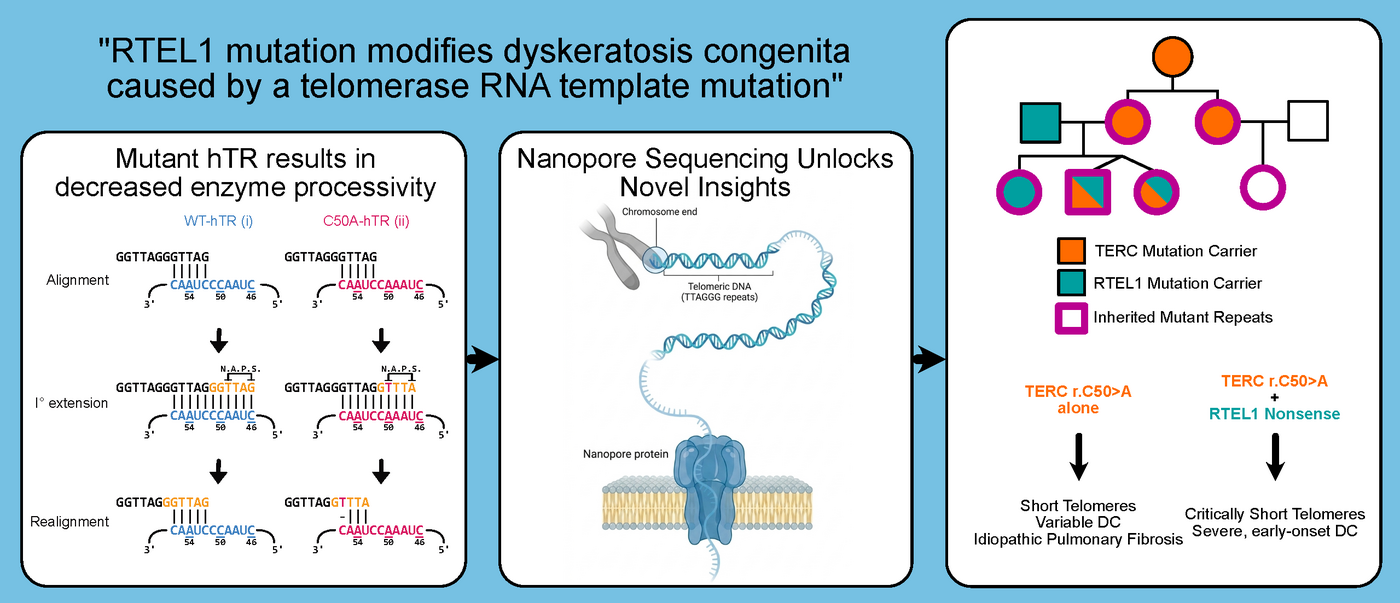
Nanopore sequencing unlocked the genetic basis of disease in the family.

Prof. Peter Baumann

Prof. Susann Schweiger
Mutations affecting telomeres – the protective caps at the ends of our DNA – cause a group of rare genetic diseases called telomere biology disorders. In a new study published in Nature Communications, researchers in the labs of Prof. Peter Baumann, Institute of Molecular Biology (IMB) & Johannes Gutenberg University Mainz (JGU), and Prof. Susann Schweiger, IMB & University Medical Center (UMC) Mainz, reveal how a mutation in the RNA component of telomerase causes premature telomere shortening in dyskeratosis congenita. They also show how an additional mutation in a gene called RTEL1 can explain why some family members developed more severe disease than others. Such information can be extremely valuable for helping clinicians better assess risks and counsel patients and their families.
Dyskeratosis congenita is a rare genetic disorder caused by defects in telomeres, which are repetitive DNA sequences that protect the ends of our chromosomes. Each time a cell divides, its telomeres become shorter. To counteract this loss, our cells have an enzyme called telomerase that replenishes telomeric DNA using an RNA subunit as a template.
In dyskeratosis congenita, the cells cannot replenish their telomeres. Loss of the protective telomeric sequences causes cells to stop dividing, so that our bodies cannot renew their cells. This leads to symptoms like bone marrow failure, lung disease and other signs of premature ageing, such as greying hair. However, patients often have highly variable symptoms, even within the same family, and the inheritance patterns of the disease can be complex, making it difficult for clinicians to counsel patients.
Mutations in the telomerase RNA template reduce telomere extension efficacy
In this study, Peter, Susann and their teams investigated a family suffering from dyskeratosis congenita. They discovered that the root cause of the disease was a mutation in TERC, the gene encoding the RNA subunit of telomerase. In humans, telomeres consist of repeated “GGTTAG” sequences. The mutation changed the template sequence by a single nucleotide, so that telomerase using the mutant copy of the RNA subunit adds the altered repeat “GTTTAG”. This small change had dramatic effects – the mutant telomerase was five times less efficient at adding protective repeats to the end of the telomere. As a result, family members with the mutation had telomeres shorter than 99% of the population.
Genome-wide sequencing reveals additional mutations that exacerbate disease
Inexplicably, both disease symptoms and telomere lengths varied significantly between family members with the mutation. By sequencing their entire genomes, the researchers discovered that the individuals with especially severe, early-onset disease had also inherited a previously unknown mutation in RTEL1, a gene important for maintaining telomere integrity. In contrast, family members with only the RTEL1 mutation had short telomeres but no obvious disease.
“For affected families, a genetic diagnosis is only the beginning. Understanding the additional genetic factors that influence disease severity can help clinicians provide more accurate risk assessments, guide follow-up care and improve genetic counselling for future generations.”
- Prof. Susann Schweiger, Adjunct Clinician, IMB Mainz & Director of the Institute of Human Genetics, UMC Mainz
Shortened telomeres are inherited across generations
The researchers also used conventional whole-genome sequencing and Oxford Nanopore long-read sequencing to map the telomeric repeats in each family member. This allowed them to see for the first time how telomeres change across generations. Interestingly, family members who did not inherit the TERC mutation still had telomeres containing mutant telomere repeats, even as adults. The researchers speculate this may indicate that telomerase only works to a very limited extent within a person’s lifetime, and that telomere lengths usually remain relatively stable across generations.
“One of the biggest unanswered questions in telomere biology is how often telomeres are rebuilt during a person’s lifetime. The mutation our clinicians discovered acted like a molecular time stamp inside the telomeres of the affected family members and their children. By tracking the mutant telomeric repeat signature, we discovered that much of the telomere sequence inherited at birth persists for decades.”
- Prof. Peter Baumann, Adjunct Director, IMB Mainz & Professor of Molecular Biology, JGU Mainz
“In addition to nicely demonstrating the need to search for genetic modifiers in patient data, this study illustrates how Nanopore long-read telomere sequencing has created new opportunities to study telomere sequence and turnover. A trackable mutant telomeric repeat allows for unprecedented insights into telomere biology.”
- Nathaniel Deimler, Bioinformatician, Baumann Lab, JGU Mainz
This research helps clinicians better understand why disease severity varies so widely in telomere biology disorders, even amongst family members. It also helps explain why family members might be affected for multiple generations, even when the original mutation is no longer present. Finally, these findings reveal crucial clues on how telomerase works in humans, advancing our understanding of the biology of ageing.
Further details
Read the full paper here: https://doi.org/10.1038/s41467-026-76650-w
Peter Baumann is an Adjunct Director at the Institute of Molecular Biology (IMB), a Professor of Molecular Biology at Johannes Gutenberg University Mainz (JGU), Director of the Centre for Healthy Ageing, Mainz and Founding and Executive Director of the Institute of Quantitative and Computational Biosciences (IQCB), Mainz, Germany. Further information about research in the Baumann lab can be found at www.imb.de/baumann.
Susann Schweiger is an Adjunct Clinician at the Institute of Molecular Biology (IMB) and the Director of the Institute of Human Genetics at the University Medical Center (UMC) Mainz. Further information about research in the Schweiger lab can be found at www.imb.de/schweiger.
This work was funded in part by the Alexander von Humboldt Foundation and the Deutsche Forschungsgemeinschaft (German Research Foundation, DFG).
About the Institute of Molecular Biology gGmbH
The Institute of Molecular Biology gGmbH (IMB) is a centre of excellence in the life sciences that was established in 2011 on the campus of Johannes Gutenberg University Mainz (JGU). Research at IMB focuses on the cutting-edge fields of epigenetics, genome stability, ageing and RNA biology. The institute is a prime example of successful collaboration between a private foundation and government: The Boehringer Ingelheim Foundation has committed 154 million euros to be disbursed from 2009 until 2027 to cover the operating costs of research at IMB. The State of Rhineland-Palatinate has provided approximately 50 million euros for the construction of a state-of-the-art building and is giving a further 52 million in core funding from 2020 until 2027. For more information about IMB, please visit: www.imb.de.
About the Centre for Healthy Ageing
The Centre for Healthy Ageing (CHA) is a virtual research centre established in 2021. It brings together scientists in basic and clinical research from across Mainz who focus on ageing and age-related diseases. Participating researchers are from the Institute of Molecular Biology (IMB), which is also responsible for coordinating the CHA, Johannes Gutenberg University Mainz (JGU), its University Medical Center (UMC), the Leibniz Institute for Resilience Research (LIR), and Translational Oncology Mainz (TRON). Research at the CHA aims to promote healthy ageing and spark discoveries that could lead to the development of treatments to prevent or cure age-related diseases. For more information, please visit www.cha-mainz.de.
About Johannes Gutenberg University Mainz
Johannes Gutenberg University Mainz (JGU) is a globally recognized research-driven university with around 31,000 students from over 120 nations. Its core research areas are in particle and hadron physics, the materials sciences, and translational medicine. JGU's success in Germany's Excellence Strategy program has confirmed its academic excellence: In 2018, the research network PRISMA+ (Precision Physics, Fundamental Interactions and Structure of Matter) was recognized as a Cluster of Excellence – building on its forerunner, PRISMA. Moreover, excellent placings in national and international rankings as well as numerous honors and awards demonstrate the research and teaching quality of Mainz-based researchers and academics. Further information at www.uni-mainz.de.
Boehringer Ingelheim Foundation
The Boehringer Ingelheim Foundation is an independent, non-profit organization that is committed to promoting the medical, biological, chemical, and pharmaceutical sciences. It was established in 1977 by Hubertus Liebrecht (1931–1991), a member of the shareholder family of the Boehringer Ingelheim company. Through its funding programmes Exploration Grants, Plus 3, and Rise up!, the Foundation supports excellent scientists during critical stages of their careers. It also endows the prestigious Heinrich Wieland Prize and awards for emerging scientists. Additionally, it funds institutional projects combining AI and biomedicine, such as the AITHYRA institute in Vienna and a new research unit at the Center for Systems Biology in Dresden (BioAI Dresden). Other supported institutions include the Institute of Molecular Biology (IMB) in Mainz and the European Molecular Biology Laboratory (EMBL) in Heidelberg, both in Germany.
Press contact for further information
Dr Ralf Dahm, Director of Scientific Management
Institute of Molecular Biology gGmbH (IMB), Ackermannweg 4, 55128 Mainz, Germany
Phone: +49 (0) 6131 39 21455, Email: press(at)imb.de