Wild Lab
Research Publications Group Members BiographySystems medicine – a holistic approach to promoting healthy ageing

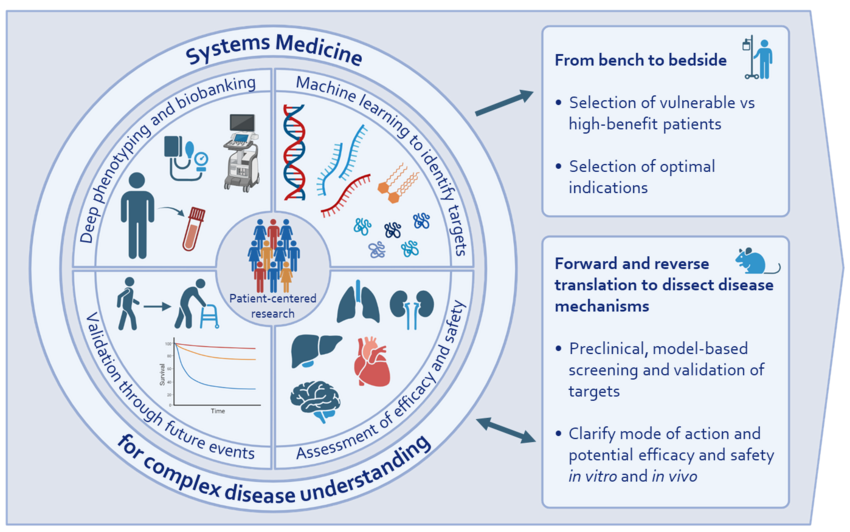
The Systems Medicine Group has comprehensive experience in molecular epidemiology and systems medicine research. We focus on investigating complex common diseases, which are strongly driven by the ageing process. Our research themes range from cardiovascular diseases, such as thrombotic disease and heart failure, to cardiometabolic conditions like obesity and type 2 diabetes mellitus, as well as infectious diseases with system-wide sequelae (SARS-CoV-2 and COVID-19) and cancers. The study of how the ageing process induces pathological changes is highly clinically relevant and a key priority for our group.
Developing tailor-made therapeutic treatments for disease
By using artificial intelligence (AI) methods and state-of-the-art high-throughput omics profiling techniques, we holistically integrate multi-omics data with environmental exposures, (sub)clinical parameters and advanced imaging data to discover new biomarkers and biosignatures, detect diseases at an earlier stage and predict their further progression. This is the basis for the development of tailor-made therapies, diagnostics and prognostics, and therapy monitoring tools to determine a patient’s response to therapy. A key strength of our group is our large multidisciplinary team, spanning expertise from molecular biology, biomedicine and clinical and molecular epidemiology to bioinformatics and biostatistics/AI and disciplines critical to maintaining a large clinical research infrastructure (e.g. IT, biobanking, regulatory affairs).
Exemplary highlights
2023 was marked by several milestones for our group: the BMBF-funded cluster of excellence curATime (curatime.org; funding for the first 3 of 9 years: €15 million) was launched, which I was significantly involved in coordinating and managing as Principal Investigator and the group was involved in implementing. This was accompanied by an influx of new team members, many recruited through the IMB International PhD Programme (IPP). In this consortium, we collaborate with basic researchers, drug developers (TRON, BioNTech), large and medium-sized pharmaceutical companies, as well as small and medium enterprises. Our aim is to identify and evaluate new therapeutic targets for the treatment, diagnosis, monitoring and prognosis of atherothrombosis, and to translate these into actionable interventions, particularly using innovative RNA-based immunotherapies.
We have also significantly expanded our multi-omics resources: we successfully established the newly launched (Q3-2023) Olink Explore HT platform (Olink Proteomics, Uppsala, Sweden; now acquired by Thermo Fisher Scientific). This platform uses dual antibodies, oligonucleotide barcoding and a combination of real-time PCR and next-generation sequencing to sensitively and specifically quantify more than 5,400 proteins, making it the most advanced high-coverage proteomics platform on the market. The Targeted Proteomics Laboratory in the Systems Medicine Group is one of the first in the world to be certified for this platform and has measured over 3,000 samples for use in large-scale human studies. This has resulted in a unique new set of several thousand plasma protein measurements in multiple biodatabases, with unprecedented resolution over the systems-wide protein profile (i.e. the measurement of organ-based microvesicles). In addition to these measurements, we have further expanded our clinical epigenetics resources by expanding DNA methylation measurements (Illumina MethylationEPIC 850k array). With a combined sample size of more than 5,000 individuals with DNA methylation measurements, this dataset is one of the five largest cohorts of its kind in the world. The project builds on the existing EpiHF project (collaborators: Christoph Niehrs, IMB, and Steve Horvath, Altos Labs, USA), a collaboration of the ReALity/SHARP network.
In addition to several exciting new publications in the areas of thrombosis, heart failure and epigenetics, in 2023 we also explored the emerging field of autoantibodies as regulatory mechanisms in both physiological and pathophysiological states. A landmark publication by our team in the European Heart Journal (Müller FS et al, 2023) was described by the journal as a "game changer in epidemiological studies". The paper showed that autoantibodies to chemokine receptor 3 (CXCR3) were detectable in unselected individuals from the general population without autoimmune disease or cancer, and that these were modulated by characteristics such as age, cardiovascular disease, chronic lung disease and declining renal function. They were also associated with structural and functional changes in the heart and could predict all-cause death and cardiovascular outcomes up to 14 years in advance. In a translational collaboration with the team of Gabriele Riemekasten (University Medical Center Schleswig-Holstein Campus, Lübeck), active and passive immunisation experiments in mice confirmed that CXCR3 plays a critical role in the development of atherosclerotic lesions, and further data from humans showed that CXCR3 expression is increased in unstable atherosclerotic plaques. We are currently involved in several other projects to further explore the role of the autoantibodiome in health and disease – a promising new direction.